HCM Analytics
Voluntary & Involuntary Turnover Rate
Quick Tip: Watch this short tutorial to see the HCM Dashboard in action.
Overview
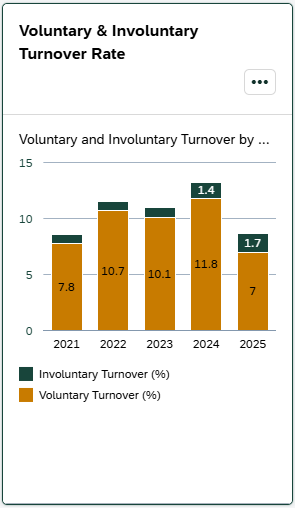
The Voluntary & Involuntary Turnover Card tracks the percentage of benefit-eligible employees who terminated or retired during the fiscal year.
Turnover is divided into two categories:
- Voluntary Turnover (%)
- Involuntary Turnover (%)
This card helps users monitor overall turnover trends and understand how different types of separations contribute to workforce change over time.
Key Metrics & Definitions
> Voluntary Turnover: Separations initiated by the employee
-
- Includes: Terminations & Retirements
- Excludes: Employees with termination reasons of End of Fixed Term Appointment are excluded from turnover calculations, as these represent the completion of an agreed-upon employment period rather than an unexpected separation.
| Voluntary Turnover Rate = |
# of voluntary terminations or retirements that occurred between 7/1 and 6/30
average # of benefit-eligible employees that fiscal year* |
> Involuntary Turnover: Separations initiated by MSU
-
- Includes: Terminations & Retirements
- Excludes: Employees with termination reasons of End of Fixed Term Appointment are excluded from turnover calculations, as these represent the completion of an agreed-upon employment period rather than an unexpected separation.
| Involuntary Turnover Rate = |
# of involuntary terminations or retirements that occurred between 7/1 and 6/30
average # of benefit-eligible employees that fiscal year* |
*Average # of Benefit Eligible Employees
| *Average # of benefit eligible employees = |
# of active/inactive employees on 7/1 + # of active/inactive employees on 6/30
2 |
Security & Access
The Voluntary & Involuntary Turnover Card is available to users with the following roles:
- Report Administrator
- Report Administrator Sensitive
Org-based security applies; users will only see data for organizations they are permissioned to access.
Drilldown Page
Select any data point within the card to open the drilldown page for that fiscal year. To view a different fiscal year, adjust the Fiscal Year filter at the top of the page.
> Filters
The following filters can be applied on the drilldown page. Click 'Go' to apply your selections.
|
Visible by Default |
Available through 'Adapt Filters' |
*Required filter |
|
> Default Views
-
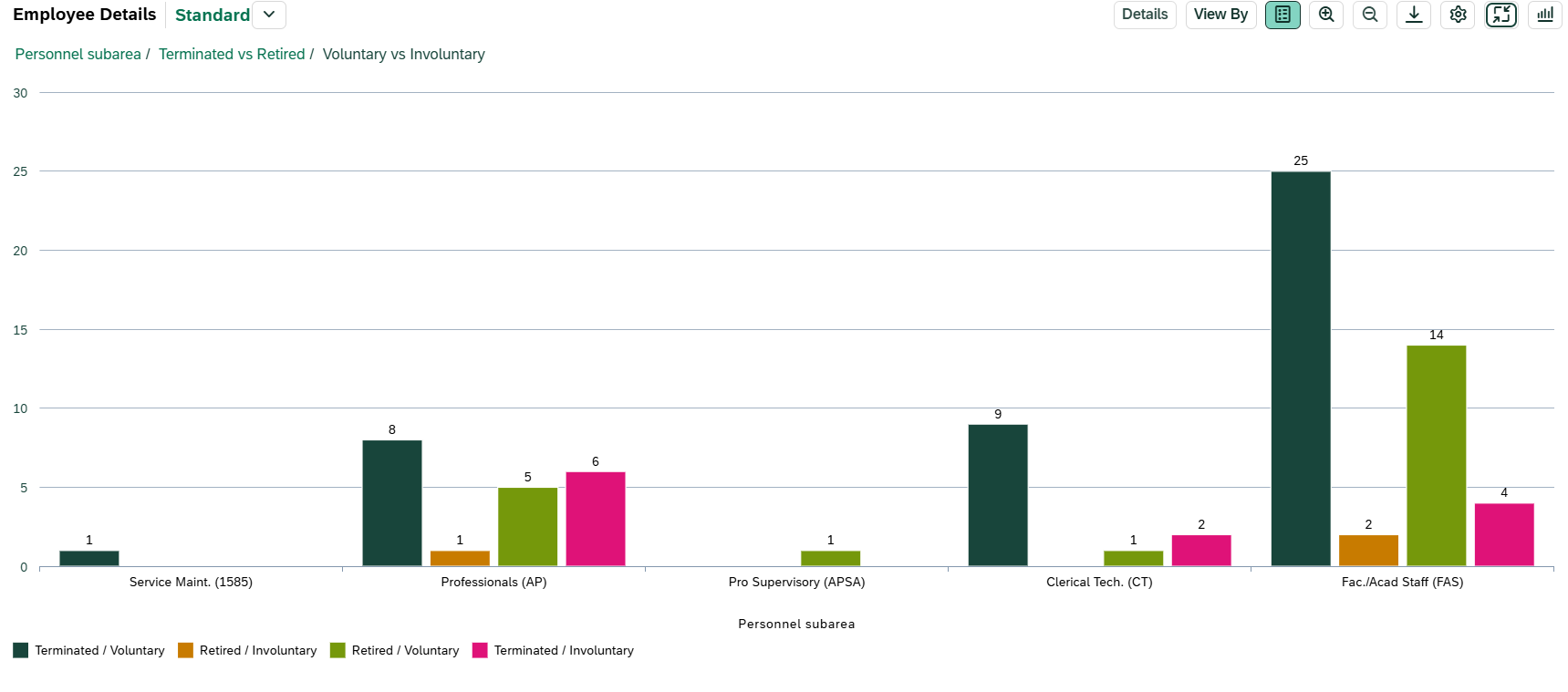
- Chart View: Displays employee terminations and retirements by personnel subarea, broken down by voluntary and involuntary separations.
-
-
Table View: Displays the following fields by default:
- Employee Name
- Personnel Subarea
- Employee Group
- Employee Subgroup
- Organizational Unit
- Job
- Terminated vs. Retired
- Voluntary vs. Involuntary
-
Table View: Displays the following fields by default:
> Customizing Your View
You can personalize the chart and table to better align with your analysis needs. Click the gear icon to add, remove, or reorder dimensions. For a brief walkthrough, see the Customizing & Saving Views video.

Available dimensions include:
|
|
|
Interpreting the Data
Please review the Interpreting the Data section on the main dashboard help page. It highlights key considerations—such as effective dates and organizational changes—that may influence results.